FROM BASKETBALL COURT TO CULTURAL ICON
The Nike Air Force 1 began as a performance basketball shoe in 1982 and became one of the most influential sneakers in history. Designed by Bruce Kilgore, the AF1 moved from NBA courts to the streets, hip-hop, fashion and sneaker collecting while maintaining one of the most recognizable silhouettes ever created.
Few sneakers have crossed as many boundaries as the Nike Air Force 1. Introduced as a performance basketball shoe in 1982, the Air Force 1 eventually moved far beyond the court, becoming a fixture in music, fashion, street culture, and everyday style. More than four decades later, its unmistakable silhouette continues to evolve without losing the identity that made it iconic.
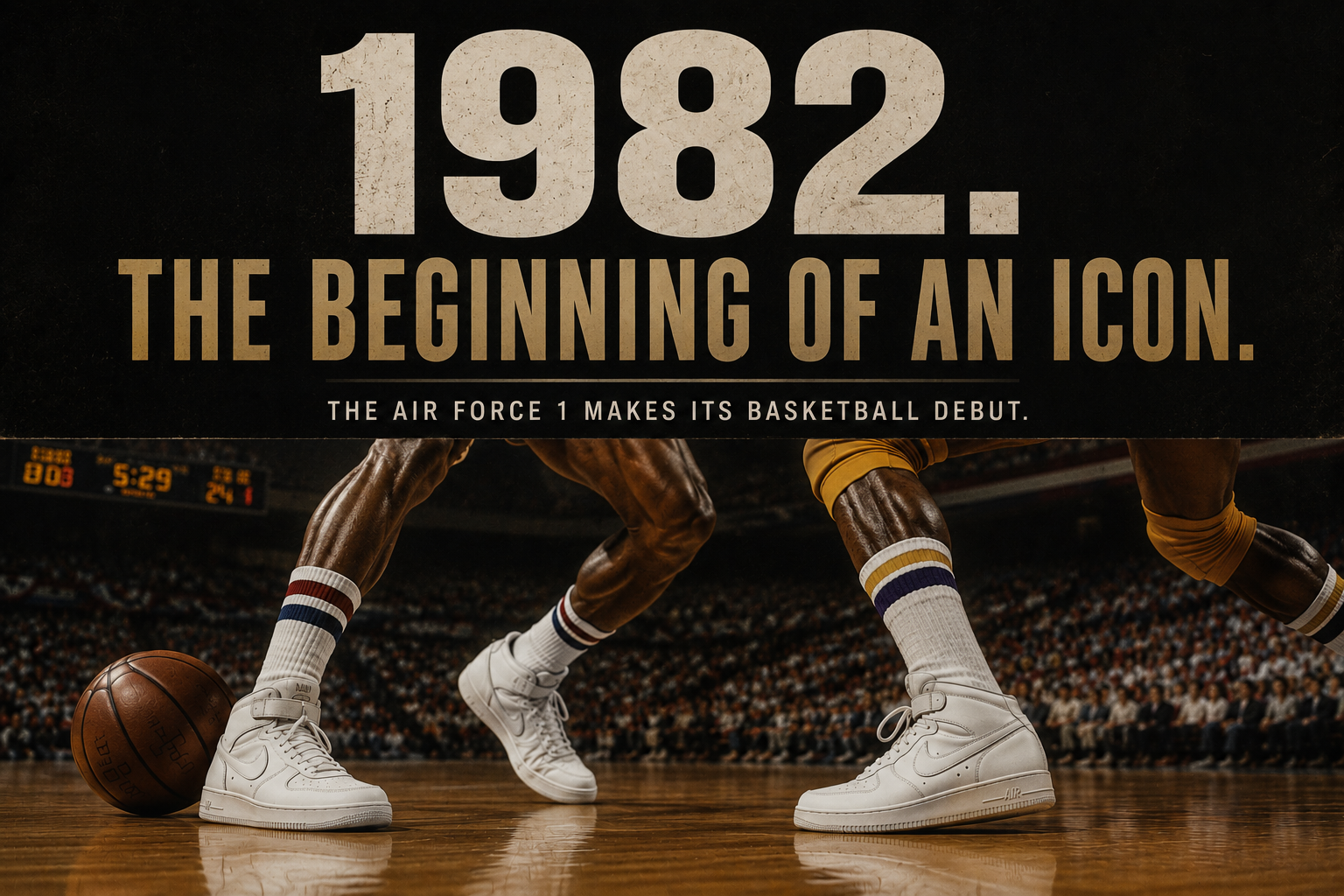
1982: WHERE IT STARTED
The Air Force 1 arrived in 1982 as Nike’s first basketball shoe to feature Nike Air cushioning. Designed by Bruce Kilgore, the original high-top model was built for performance, with a circular outsole pattern, ankle strap, and a shape that felt substantial without looking bulky. Its name referenced Air Force One, the aircraft used by the President of the United States — a fitting choice for a shoe Nike intended to position above the rest.
1983: THE ORIGINAL SIX
A year after its introduction, the Air Force 1 was worn by six prominent NBA players: Michael Cooper, Bobby Jones, Moses Malone, Calvin Natt, Mychal Thompson, and Jamaal Wilkes. Nike used that group to establish the AF1 as a serious performance basketball shoe, but the silhouette was already beginning to build an identity beyond the court.
1985: BALTIMORE KEPT IT ALIVE
One of the most important chapters in Air Force 1 history happened away from Nike headquarters. Three Baltimore retailers helped reintroduce the shoe in special colorways, including royal blue and chocolate brown. According to Nike, roughly 3,000 pairs sold almost immediately. That demand helped prove that the Air Force 1 had life beyond its original basketball purpose.
The Baltimore story also helped shape what became known as the Shoe of the Month model: limited colorways, selected retailers, and a sense of scarcity that encouraged people to travel for specific pairs. Long before sneaker drops became a global ritual, the Air Force 1 was already teaching the industry how exclusivity could create culture.
FROM PERFORMANCE SHOE TO STREET UNIFORM
By the late 1980s and through the 1990s, the Air Force 1 increasingly became a lifestyle shoe. Its simple shape made it easy to wear, while the combination of leather construction, a substantial sole, and clean color blocking gave it a presence that worked far beyond basketball.
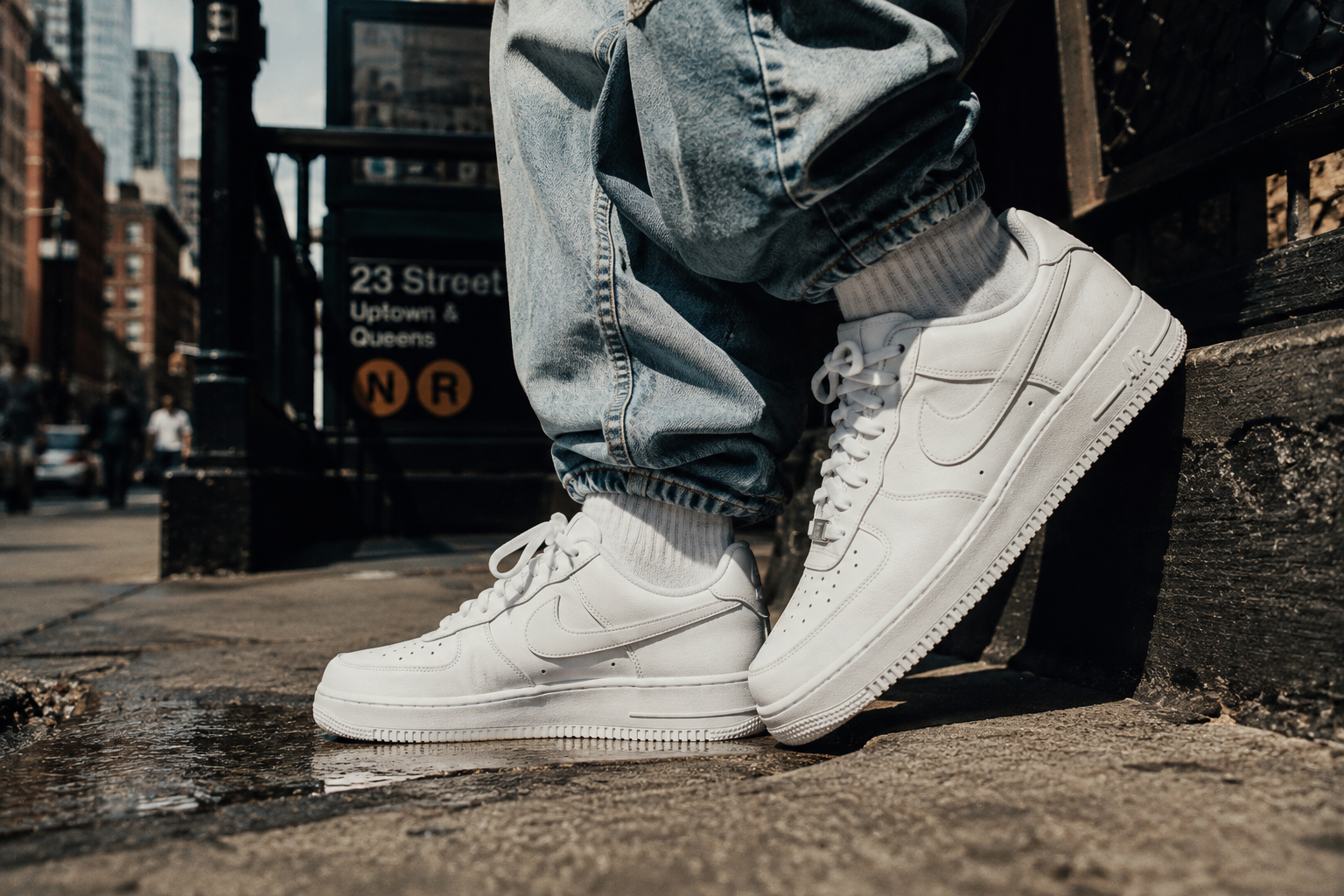
The white-on-white version became especially important. Its simplicity made it adaptable to different cities, styles, and generations. Nike still describes the classic white AF1 as a shoe that moved from basketball courts into street culture and hip-hop while remaining one of the silhouette’s defining looks.
HIP-HOP MADE IT BIGGER THAN BASKETBALL
By the late 1990s and early 2000s, the Air Force 1 had become deeply connected to hip-hop. Artists wore it, referenced it, collected it, and helped turn particular colorways into cultural signals.
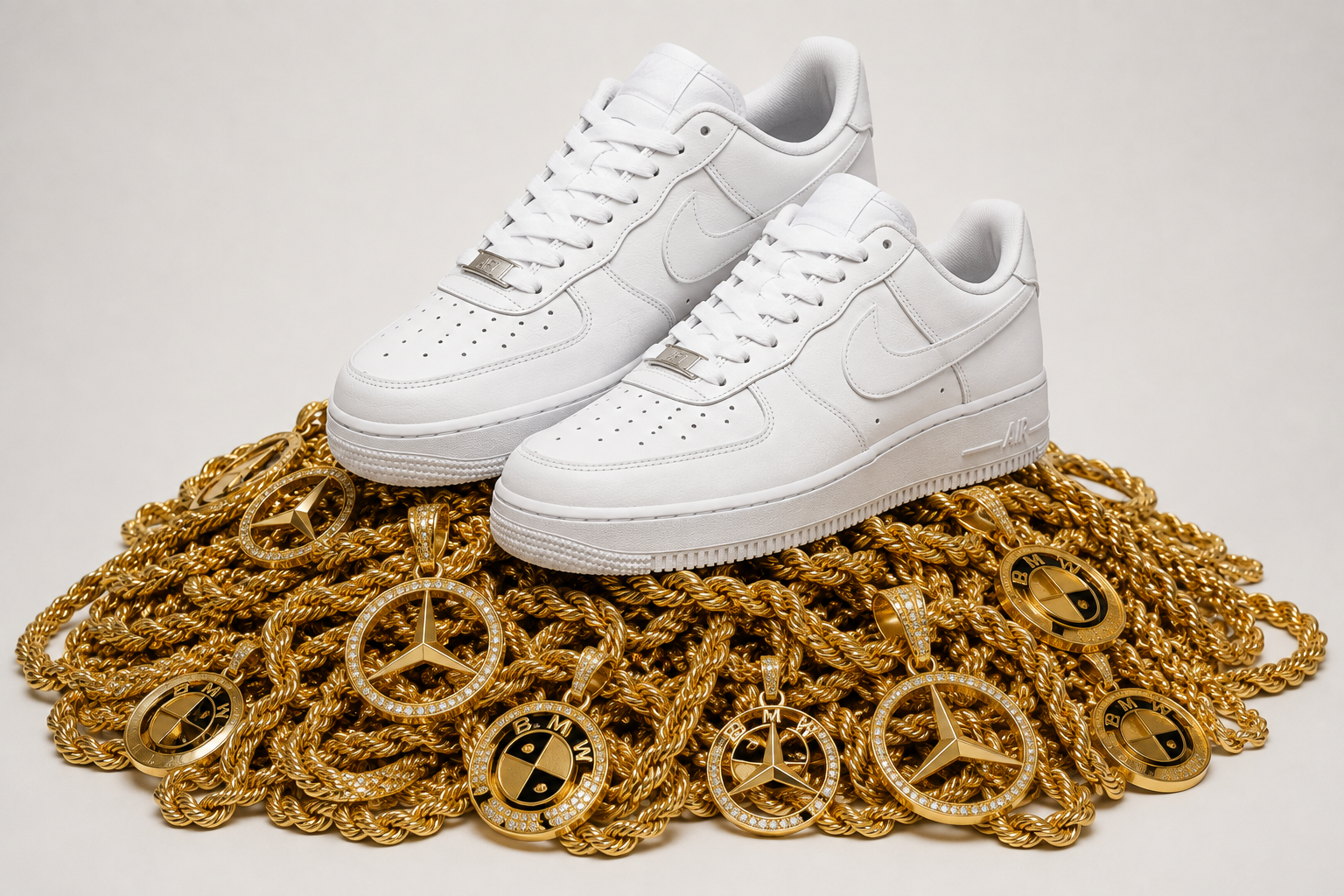
Nike itself identifies the year 2000 as a major point in that evolution, when the sneaker’s popularity among influential rappers and artists pushed it even further beyond sport. Roc-A-Fella Records also received a white-on-white edition featuring the label’s embroidered logo, helping establish the AF1 as a canvas for cultural collaborations.
THE RISE OF COLORWAYS AND COLLECTING
The Air Force 1’s basic silhouette barely needed to change. Instead, color, materials, exclusivity, and storytelling became the variables.
Over time, Nike released premium editions, regional exclusives, holiday releases, special materials, artist collaborations, and limited collections. That flexibility allowed one recognizable shoe to exist in thousands of different forms while still looking unmistakably like an Air Force 1. Nike notes that collaborations have explored treatments ranging from laser etching to crocodile-style finishes.
That is one of the reasons the model works so well for collectors: people can stay loyal to one silhouette while still chasing something completely different.
THE WHITE-ON-WHITE STANDARD
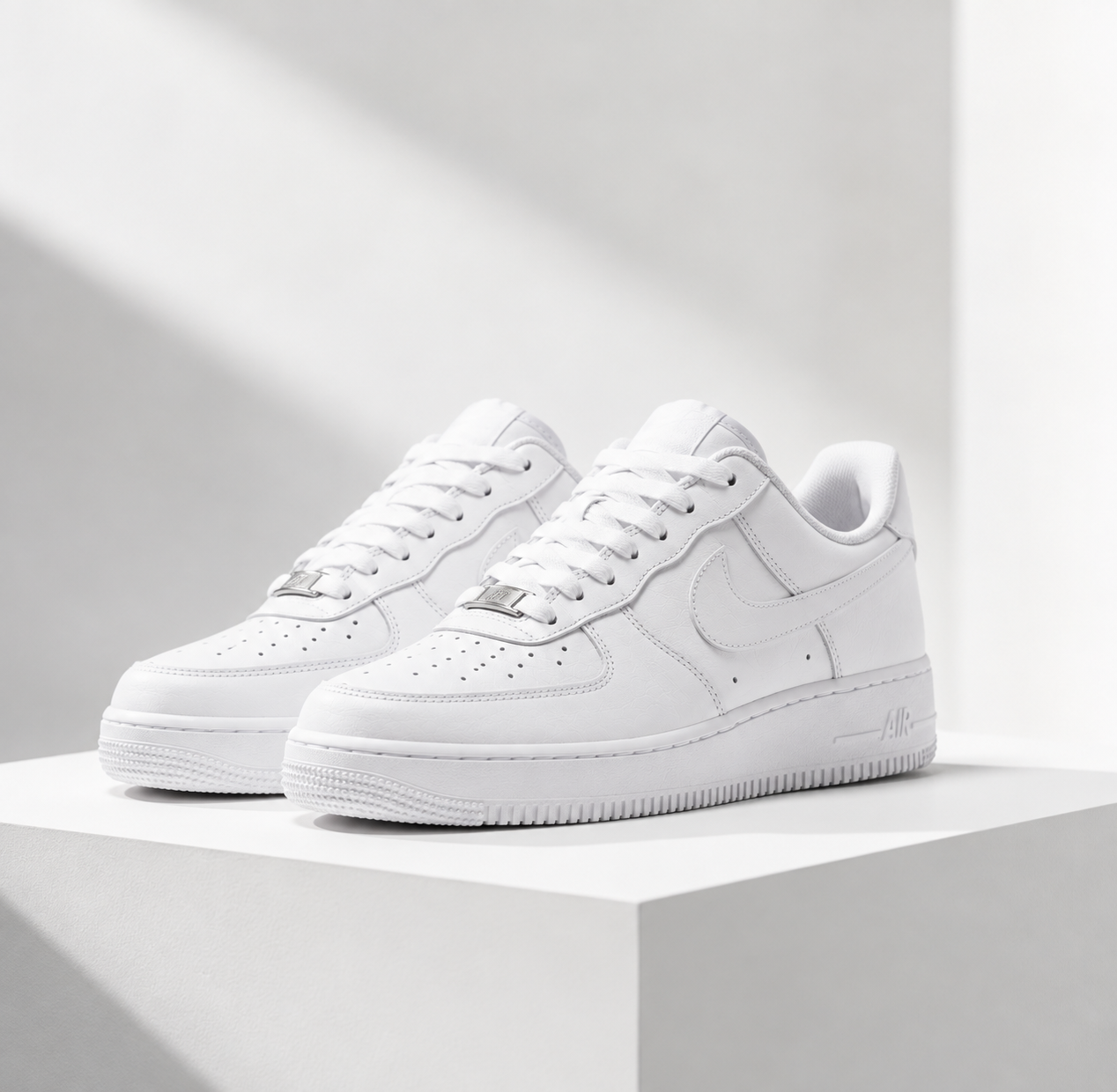
For all the rare collaborations and unusual releases, the all-white Air Force 1 remains the foundation.
It is simple enough to work with almost anything, recognizable from across a room, and accessible in a way that many limited sneakers are not. Its popularity also helped make the Air Force 1 something unusual in sneaker culture: both an everyday staple and a collectible platform.
That dual identity is central to the AF1 story. A person can buy one pair and wear it into the ground—or build an entire collection around the same basic silhouette.
WHY THE DESIGN LASTED
Part of the Air Force 1’s staying power comes from the fact that its original design was already strong.
Bruce Kilgore drew some inspiration from Nike’s Approach hiking boot when considering support and comfort. The AF1 introduced Nike Air cushioning to basketball footwear, while features such as the perforated toe, padded collar, durable leather construction, rubber outsole, and pivot-circle traction pattern became lasting parts of its identity.
The technology mattered at launch. But eventually, the silhouette itself became the bigger story.
LOW, MID, AND HIGH
The Air Force 1 has evolved across three primary forms:
Low became the dominant everyday lifestyle version.
Mid added more ankle coverage while keeping much of the familiar AF1 profile.
High stayed closest to the shoe’s basketball origins, including the ankle-strap identity associated with early versions.
The differences give people room to choose how they want to wear the silhouette without leaving the Air Force 1 family.
Not sure how the silhouette fits? Read the Air Force 1 Sizing Guide.
COLLABORATIONS CHANGED THE CEILING
As sneaker culture became more global, collaborations pushed the Air Force 1 into luxury fashion, art, music, and collector territory.
Artists, labels, designers, retailers, and cultural institutions have all interpreted the model. Each collaboration proves the same underlying point: the AF1’s shape is recognizable enough to survive dramatic changes in material, color, construction, and storytelling.
That makes the Air Force 1 more than a product. It functions almost like a blank canvas.
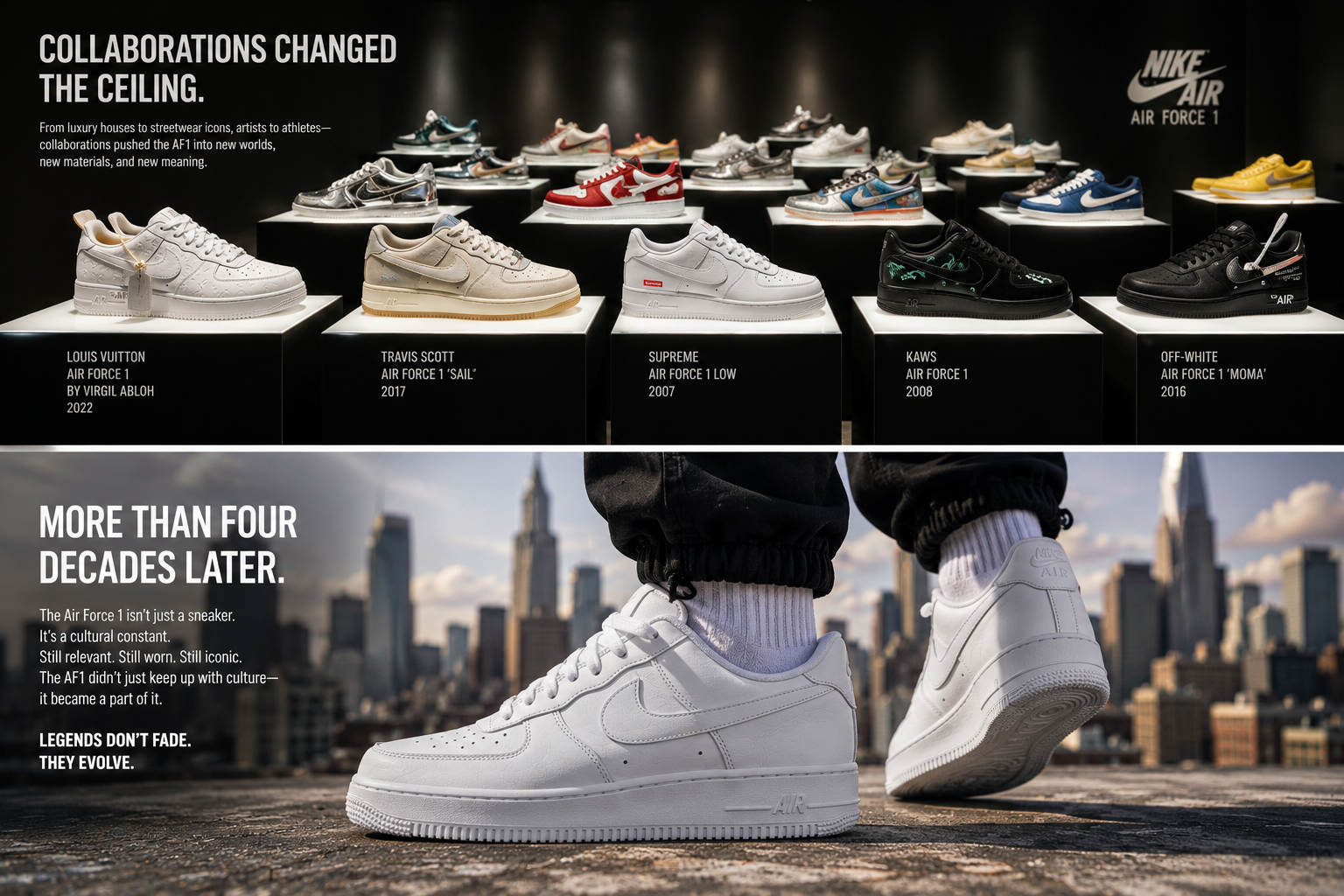
MORE THAN FOUR DECADES LATER
The Air Force 1 is still being redesigned, rereleased, collected, worn daily, and adapted into new categories. In 2026, Nike even introduced a skate-specific SB Air Force 1, showing that a silhouette born in basketball can continue finding new performance and cultural contexts more than forty years later.
Few sneakers get that kind of lifespan.
Most designs belong to a particular era. The Air Force 1 has repeatedly found ways to belong to the next one.
WHY IKNO FOCUSES ON THE AIR FORCE 1
That history is exactly why IKNO exists.
The Air Force 1 is not one shoe in the ordinary sense. It is a family of colorways, collaborations, rare releases, classics, regional stories, cultural moments, and personal memories built around one recognizable silhouette.
At IKNO, our goal is to document that world: the pairs worth knowing, the stories behind them, and the places where people can find them.
One silhouette. Decades of culture. Endless ways to leave your mark.